Divorcing a
narcissist in Texas.
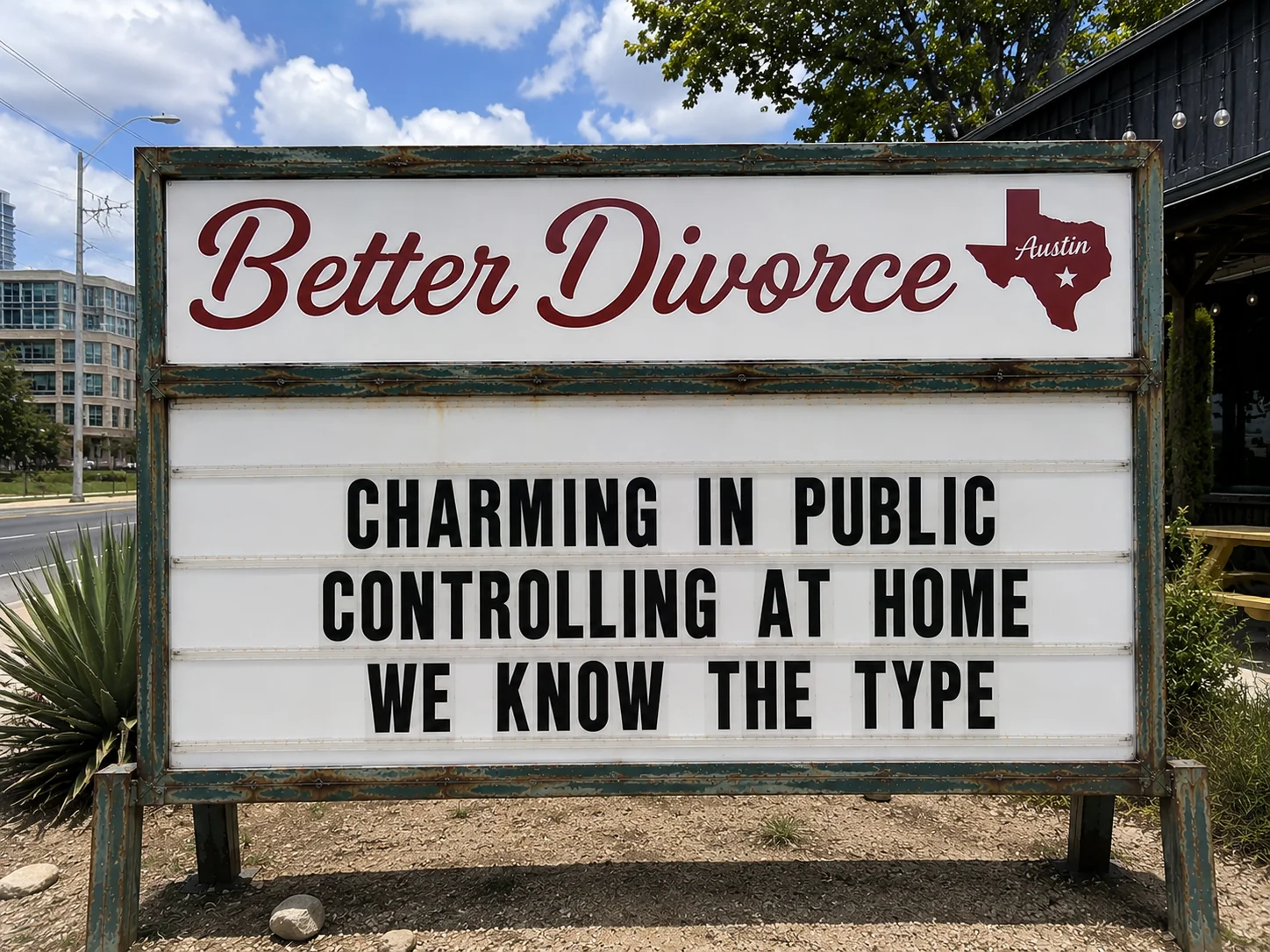
"We do not diagnose people in court.
We describe the behavior — and let the pattern tell the story."
When the dynamic
has a name.
If you are reading this, you may have started to recognize a pattern: a spouse who twists conversations until you doubt your own memory, who is charming in public and controlling at home, who uses the children to maintain leverage, who escalates anything you try to resolve. We do not diagnose people in court — but the pattern you are describing has a name, and Texas courts know it well.
The label most people reach for is “narcissist.” That word does a specific kind of work — it tells you you are not imagining the dynamic. But in court, the word does the wrong kind of work. Judges hear “my spouse is a narcissist” routinely, and the label alone moves the case toward dismissal of the speaker, not toward action against the spouse. What moves a Texas court is a documented pattern of specific behaviors that affect the children, the marriage estate, or the case itself.
This page is about what that pattern looks like, how to document it, and what legal mechanisms Texas provides when a divorce involves a high-conflict or coercive-control dynamic.
Documentation first —
everything else second.
The single most consequential decision in a high-conflict divorce is what you start documenting and when. The cases that go well typically start documentation before filing; the cases that go poorly typically reconstruct evidence from memory after the fact.
What to keep, contemporaneously:
- Screenshots of every meaningful text and email exchange, with full context (not just the inflammatory line)
- Voice recordings where legal (Texas is a one-party-consent state, so recordings you are part of are admissible)
- A dated calendar of missed possession periods, late exchanges, schedule violations, and broken agreements
- Photographs of property damage, concerning conditions at the other parent’s home, or anything else that may become relevant
- Bank statements and financial records showing patterns — large unexplained withdrawals, new accounts, asset movements
Move all real-time communication to written channels. Apps like OurFamilyWizard and TalkingParents create a timestamped, court-admissible record automatically. Verbal agreements with a high-conflict ex have a way of changing in retelling; written ones do not.
The court needs to see a pattern, not isolated incidents. Fifteen calendared events over six months tell a story; the same fifteen events recounted under oath from memory do not.
Protecting the
children.
The children are the highest-stakes part of the case and the place where the dynamic does the most damage.
The protective work is partly legal and partly behavioral. Legally: request specific parenting-plan language that limits ambiguity (exchange times, locations, decision-making authority, communication boundaries); consider whether an amicus attorney or guardian ad litem is appropriate; in cases with documented safety concerns, request supervised exchanges or supervised possession under TFC Chapter 153.
Behaviorally: never discuss the case with the children, never speak ill of the other parent in their hearing, maintain routines as much as possible, get the children connected to a therapist experienced with high-conflict family systems. The therapist’s notes are not just protective for the kids — they sometimes become part of the case record if the therapy reveals patterns the court needs to see.
Parallel parenting
(not co-parenting).
Co-parenting assumes two parents who can communicate, compromise, and align on the children’s needs. Parallel parenting acknowledges that co-parenting is not available in this case and structures the relationship accordingly.
The parallel-parenting model:
- A detailed parenting plan that specifies when, where, how, and through whom exchanges happen — minimal interpretation required
- Communication via app only (OurFamilyWizard, TalkingParents); no calls or texts on personal numbers
- Separate school conferences, doctor’s appointments, and extracurricular events when the schedule permits it
- Clear, predetermined consequences for violations, written into the order
- No “flexibility” that becomes a tool for the other side to manipulate
This feels harsh on paper. In practice, it protects the parent’s sanity and the children’s stability. The boundaries are not punitive — they are operational.
Bill Eddy’s BIFF method (Brief, Informative, Friendly, Firm) is the communication protocol that pairs with the parallel-parenting structure. We coach clients on it during the case and recommend the method for life after the decree.
Financial
protection.
A high-conflict spouse often uses finances as a control mechanism, before and during divorce. The protective steps to consider early:
- Open accounts in your name only at a bank where the other spouse does not have access
- Document all marital assets and debts thoroughly before the filing — the inventory you can produce later is only as good as what you captured now
- Pull the last three to five years of tax returns and joint financial statements; look for accounts, businesses, or income streams you were not aware of
- Be alert to large unexplained withdrawals, transfers, or asset movements as the divorce becomes likely
- When the marital estate is significant or there are signs of hidden income, a forensic accountant may be the highest-leverage expert in the case
During the divorce, request detailed financial disclosures, automatic income withholding for any ordered support, and provisions for tracking payments. Build consequences for late or missed support into the order itself — enforcement is easier when the order is specific about what counts as a violation.
What to expect
in court.
A high-conflict spouse often presents very well to outsiders, including judges. The strategy that consistently works is to be the calm, prepared, documented side of the courtroom.
What the high-conflict side typically tries:
- Presenting as the reasonable, generous party
- Casting you as the unstable, vindictive, or alienating one
- Generating motion practice that drains your resources
- Violating the spirit of orders while staying technically within the letter
- Using the children as positioning devices
What works against it:
- Factual, unemotional testimony
- Letting documentation carry the case rather than narrative
- Refusing to take provocations on email, in court, or at exchanges
- Professional dress, courteous tone with the judge, focused answers
- Keeping the focus on the children’s needs and your own conduct, not the spouse’s character
Judges see these patterns repeatedly. Your job is not to convince the judge that your spouse has a personality disorder; your job is to present a record so clear that the judge does not need to be told.
Protective orders,
when they fit.
When there is documented family violence — physical assault, credible threats, stalking, coercive-control conduct that meets the statutory definition — a protective order under Texas Family Code Chapter 85 may be appropriate.
Travis, Williamson, and Hays counties all have protective-order dockets and procedures for emergency relief. A protective order can include provisions for exchange logistics, communication restrictions, and exclusion from the residence — protections that extend through the divorce proceeding and beyond.
Protective orders are not the right tool for every high-conflict case; they require specific factual predicates and they carry consequences for the respondent that the court takes seriously. When the facts support one, it is one of the strongest legal protections Texas offers. When the facts do not, alternative measures — kick-out orders, exclusive use, no-contact provisions in temporary orders — may serve the same protective purpose without the protective-order machinery.
Choosing the
right counsel.
Not every Texas family lawyer is equipped for a high-conflict case. The qualities that matter:
- Trial experience — high-conflict cases are more likely to require trial than typical divorces
- Familiarity with the documentation discipline and the parallel-parenting model
- Willingness to push back when the case calls for it, without confusing aggression for strategy
- Comfort working with mental-health professionals and forensic accountants when the case requires them
- An honest read on what is winnable, what is not, and what each stage of the case will cost
The best question to ask a prospective lawyer: “Can you describe a high-conflict case you handled, what worked, and what you would do differently?” The answer reveals whether the lawyer has actually been in the room or is reciting marketing copy.
Honest answers
to fair questions.
"How does the court handle a spouse with narcissistic traits?"
Texas courts do not diagnose personality disorders. They respond to documented patterns of behavior — coercive control, financial manipulation, parental alienation, repeated violations of agreements. The legal strategy is to describe what the spouse does (specifically, with dates and evidence) rather than to label what the spouse is.
"How long does a high-conflict Texas divorce typically take?"
High-conflict divorces typically run 9 to 18 months, sometimes longer. They involve more court hearings, heavier discovery, and a higher likelihood that mediation will not resolve the case. The cases that fight the longest are usually those where one side keeps generating new motions rather than working toward resolution.
"Can I get full custody if my spouse has narcissistic traits?"
Sole managing conservatorship is available in Texas, but the bar is high. Texas Family Code defaults to joint managing conservatorship unless there is evidence that joint management would harm the child. Realistic outcomes for high-conflict cases are usually sole-managing with restrictive possession, or joint-managing with detailed parallel-parenting provisions — not the elimination of the other parent.
"What if my spouse violates court orders?"
Document every violation with date, time, what the order required, what was done or not done, and any witnesses. File contempt motions when the pattern justifies it. Consistent enforcement establishes the pattern in the record and prevents the violations from being normalized.
"Should I tell my children what their other parent is doing?"
No. Children are not the audience for adult conflict, even when the conflict is real and the behavior is wrong. Speaking ill of the other parent — even truthfully — typically backfires in court and damages the children. Process the situation with your therapist, not your kids.
"How much does a high-conflict Texas divorce cost?"
More than a straightforward divorce, and the honest range is wide. The cost driver is how hard the other side fights, how much discovery is needed, and whether expert evaluators get involved. We give a phased estimate at the consult so you can see what each stage adds, and we tell you which fights are worth having and which are not.
"What if I cannot afford a private attorney?"
Texas RioGrande Legal Aid, the Volunteer Legal Services of Central Texas, and the State Bar of Texas Lawyer Referral Service all offer paths to reduced-cost or pro bono representation in qualifying cases. The University of Texas School of Law has a Domestic Violence Clinic for cases that meet its criteria. We can also work with payment plans for clients who do not qualify for legal aid but cannot pay a standard retainer up front.
Build the
plan first.
An hour with Cristi — $250, first hour prepaid — to walk through what is actually happening, what the documentation already looks like, what protections exist in Texas, and what a realistic strategy looks like given your specific situation. We will not push you toward filing or mediation before you are ready — we will tell you what we see.